

MOSFETs are very important in many electronic projects. They assist in managing the flow of voltage and current with great effectiveness. Based on research, it is anticipated that the MOSFET global market will expand at a steady rate and achieve $45.20 billion by 2034. This growth is driven by demand for power-efficient solutions.
When you are making an amplifier, a power supply or managing a motor, it is important to choose the right MOSFET. Choosing top-grade parts makes certain your circuit works in optimal condition and stays reliable for a long time.
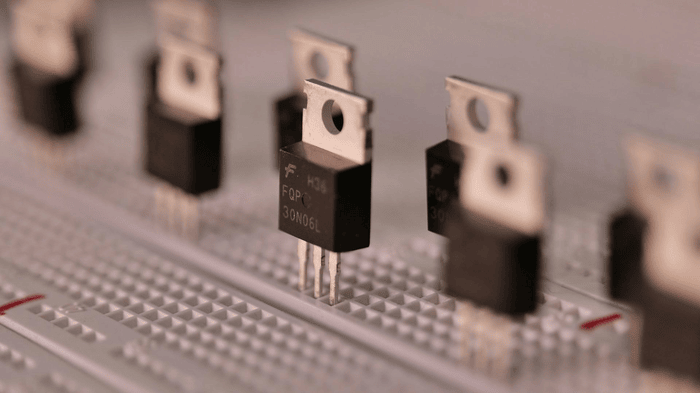
Understanding the Basics of MOSFETs
MOSFET is a type of transistor. It controls electric signals and helps in switching and strengthening them. There are two primary types of MOSFETs: N-channel and P-channel. These devices function depending on the voltage that is given to the gate terminal.
Because of their high performance, they are very much in demand for power electronics and projects with microcontrollers. Knowing about how MOSFETs operate will assist you in choosing an appropriate one according to your particular requirements.
N-Channel vs. P-Channel MOSFETs
When selecting a MOSFET, it is necessary to opt between N-channel and P-channel types. For instance, due to its lesser resistance and ability to manage higher current capacity, an N channel MOSFET often delivers more effectiveness in several applications.
As such features make them appropriate for tasks like switching circuits power inverters and motor controls, the use of N-channel MOSFETs becomes indeed suitable.
P-channel MOSFETs, on the other hand, are utilized in applications of high-side switching. They have higher resistance but work well in specific power arrangements. The choice between these two depends on the type of circuit you are designing and the voltage requirements.
Voltage and Current Ratings
Every MOSFET has voltage and current ratings. These define its maximum capacity. The drain-to-source voltage (Vds) should be higher than the maximum voltage in your circuit. The current rating should exceed the expected load. Exceeding these limits can lead to failure.
Choosing a MOSFET with a higher safety margin is a good practice. A good rule of thumb is to choose a MOSFET with at least 20% higher ratings than your circuit requires.
Rds(on) and Power Dissipation
Rds(on) is the resistance when the MOSFET is turned on. Lower Rds(on) values mean less power loss. This reduces heat and improves efficiency. Power dissipation is another key factor. If a MOSFET generates too much heat, it may require a heatsink.
Checking the datasheet helps in selecting a suitable component. Lower power dissipation ensures that your circuit runs efficiently without excessive heat buildup.
Gate Drive Requirements
MOSFETs require a fitting gate drive voltage. MOSFETs meant for logic levels function at lowered voltages, which makes them apt for microcontrollers and applications with low voltages. Standard MOSFETs need increased gate voltages.
Keeping balance with the voltage levels in your circuit helps prevent switching issues. If the gate voltage is not enough, MOSFET may fail to fully switch on which can lead to inefficiency and too much heat.
Switching Speed and Frequency
Certain applications require quick transitions. MOSFETs having less gate charge can switch faster. This is very important for circuits with high frequency such as pulse-width modulation (PWM) controllers and DC-DC converters.
If the switch speed is inadequate, power losses rise. Picking a MOSFET with good switching characteristics increases efficiency. In uses like radio frequency (RF) amplifiers, fast switching plays an important part.
Thermal Management
Heat is a major concern in power electronics. Even efficient MOSFETs generate some heat. Proper heat dissipation extends the lifespan of components.
Using heatsinks or fans helps in high-power applications. Checking the thermal resistance of a MOSFET ensures better heat control. Some MOSFETs come with built-in thermal protection, but additional cooling solutions may still be necessary for demanding applications.
Package Type and Size
MOSFETs come in different packages. Some are through-hole, while others are surface-mount. The choice depends on your PCB design.
Larger packages handle more power and dissipate heat better. Compact MOSFETs help save space but they might need extra cooling methods. For designing a small circuit, surface-mount MOSFETs could be the best option; however, these need accurate soldering skills.
Common Mistakes to Avoid
If you choose the wrong MOSFET, it could cause your circuit to not work or operate poorly. One mistake people often make is selecting a MOSFET that cannot handle enough voltage or current. Another problem can arise if they do not pay attention to Rds(on) value; this can generate too much heat.
Bad thermal management is also a common issue. Knowing these aspects assists in making smarter decisions. Always review the data sheet of MOSFET and confirm that it fulfills your project’s needs.

Conclusion
The correct selection of MOSFET needs consideration. Things such as voltage, current and resistance are very important. Understanding gate drive needs and thermal management makes for better performance. By choosing the appropriate part, your DIY project can operate both effectively and dependably. No matter if you are creating a power supply, a motor driver or an amplifier, having the correct MOSFET may be key to reaching peak performance.
